4 Day Kyoto Itinerary: The Ultimate First-Timer's Guide
Updated: Aug 26
Out of all of the cities I visited in Japan, Kyoto was my favorite. There's something about the way the city keeps switching on you. One minute you’re walking down a modern city street, and the next you turn a corner and find yourself in front of a centuries-old wooden temple gate or wandering through an ancient alleyway.
Four days was the right amount of time for me to actually settle into Kyoto instead of just sprinting through a checklist. Here's exactly how I spent it, neighborhood by neighborhood, plus the things I'd tell a friend before they go.
Day 1: Higashiyama District
I didn't rush this morning, and I'd tell you not to either. I've seen advice to arrive at Kiyomizu-dera before 9am, but honestly, getting there around 10am worked out great for me. This temple is famous for its massive wooden verandah, built without a single nail, jutting out over the hillside with the whole city spread out below it.
From Kiyomizu-dera you walk down through Sannenzaka and Ninenzaka, the preserved stone-paved streets lined with old wooden machiya houses, tea shops, and little craft stores. This stretch is also where I did most of my snacking and almost all of my souvenir shopping. There are little stalls tucked into the old storefronts selling matcha soft serve, fresh senbei, skewers, and yatsuhashi (Kyoto's cinnamon-dusted mochi sweet), so it's easy to just graze your way down the hill instead of stopping for a full meal. And the shops themselves are some of the best souvenir hunting in the city with a lot more character than what you'll find in a typical gift shop. I'd budget extra time here just for that; I kept telling myself "one more shop" the whole way down.
One thing worth knowing: if you happen to be visiting during a seasonal illumination period (Kyoto lights up several temples in spring for cherry blossom season and again in autumn for the maples), Kiyomizu-dera at night is a completely different experience. It's worth the trip back if your schedule allows it. Unfortunately, I did not visit during the illumination period, but I'm extremely jealous of those who did.
In the afternoon, I made my way north toward Ginkaku-ji, the Silver Pavilion, timing it so I hit the Philosopher's Path in the late afternoon light. It's a quiet canal-side walking trail that's lined with cherry trees in spring, green canopy in the summer, and maples in autumn, connecting back toward Nanzenji Temple and Heian Shrine.
I ended the day with a food tour led by a local, which took us through Pontocho, the narrow, atmospheric alley lined with restaurants along the Kamo River. You can read more about the food tour here. If you’d rather explore on your own, though, I highly recommend making reservations for anywhere you have your heart set on. The popular spots fill up quickly, especially on the weekend.
Day 2: Fushimi Inari, Nishiki Market & Gion
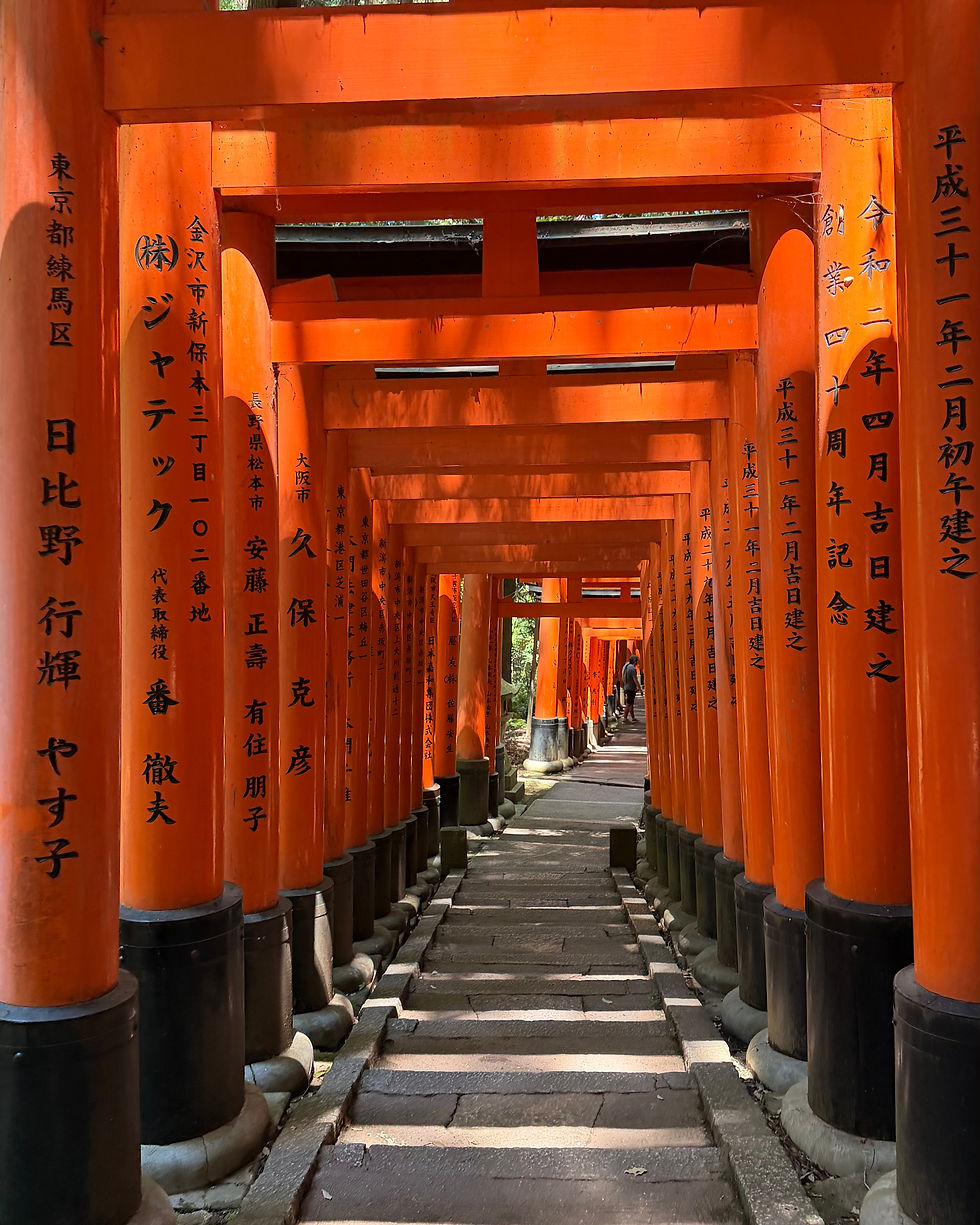
I started with Fushimi Inari early, and I'm glad I did. There's a version of this shrine with just you and the gates, and a version with three tour buses' worth of people, and the only thing separating them is how early you show up. Before 9am if you can manage it. This is the shrine with the thousands of vermilion torii gates climbing up the mountainside. We decided to hike all the way to the top, which took about 2-3 hours. You don't need to hike all the way to the summit unless you want it, but the upper trails are much quieter and worth it if your legs are willing. If you're looking to get the perfect "insta-worthy" photo with. no one else in the background, I recommend hiking a little further. About 2/3 of the way up, there is a place to rest and grab a drink or even some ice cream. I had a ramune soda-flavored ice cream and, months later, I still can't stop thinking about it.
From there I headed into central Kyoto for Nishiki Market. Make sure to go hungry. The market is huge and can honestly be quite overwhelming. One important thing to keep in mind: don’t eat while walking through the market. Finish your food near the stall where you bought it before moving on, as eating on the go is prohibited in parts of the market and can potentially result in a fine.
Here's the part I wish someone had told me: right next to Nishiki Market is a massive covered shopping arcade (the Teramachi and Shinkyogoku arcades), and it just keeps going — block after block of shops, from souvenir stalls to clothing to random little finds you didn't know you needed. I told myself I'd pop in for twenty minutes and lost almost three hours in there without noticing. Budget some real time for this area if you like to shop, because it sneaks up on you. I'm personally obsessed with Japanese streetwear.
I closed out the day in Gion, Kyoto's geisha district, timing it for around 4:30 to 6pm, which gives you the best (though never guaranteed) chance of spotting a geiko or maiko on their way to an appointment. Walking Hanamikoji Street as the lanterns come on is genuinely one of my favorite memories from the whole trip. One practical note: several of Gion's private alleyways now have photography bans with fines to protect residents' privacy, so keep your camera to the main streets, and if you do see a geisha, don't block her path for a photo.
Day 3: Arashiyama
Spending the entire day here was my favorite part of my Kyoto trip. There's so much to do so it's best to allot an entire day here rather than trying to squeeze it in.
I got the Bamboo Grove early in the morning. By noon, this place can get really busy. Right at the edge of the grove is Tenryu-ji Temple, a UNESCO World Heritage site with one of Kyoto's most celebrated Zen gardens. It's an easy add-on since you're already there, and worth paying to go inside rather than just walking past.
Then came the part I have to be honest about: Iwatayama Monkey Park. Getting up there is a real hike. It's a steep, sweaty climb up the mountain, and I definitely questioned my choices about halfway up. But it is so worth it. At the top you get wild Japanese monkeys wandering around freely, plus one of the best panoramic views over the city I found on the whole trip. And here's the fun part: there's a little hut at the top where you can actually feed the monkeys — you stay inside while they come right up to the mesh, which is a pretty surreal experience the first time a monkey looks you dead in the eye waiting for a piece of fruit. If you're up for the climb, don't skip it.
I spent the rest of the afternoon wandering along the Katsura River, where my family and I also took a short rowboat ride with a local guide doing the rowing for us.
Day 4: Northern Kyoto & Nijo Castle
My last full day started at Kinkaku-ji, the Golden Pavilion. The visit itself is quick, maybe 45 minutes, since you view it along a walking path rather than going inside.
A short trip from there is Ryoan-ji, home to Japan's most famous rock garden — fifteen stones arranged so that, from any single viewpoint, you can only ever see fourteen of them. I sat there longer than I meant to, just trying to find the angle that showed all fifteen. You won't find it, and that's the point.
In the afternoon I headed back toward central Kyoto for Nijo Castle, the former residence of the Tokugawa shoguns. The whole place is fascinating, but the detail that stuck with me was the "nightingale floors." The wood is designed to chirp underfoot as a built-in alarm system against intruders.
For my last evening, my sister and I decided to make our own custom engraved rings at Glänta. Afterwards, we stuck around the Kawaramachi and Teramachi shopping streets and grabbed a final dinner back near Pontocho. It felt like the right way to close out the trip, in the same part of the city where it started.
My Top 3 Hotels for This Itinerary:
⭐ The Ritz-Carlton, Kyoto — best for riverside luxury and central location. Click here for rates and availability.
⭐ Park Hyatt Kyoto — best for the ultimate Kyoto atmosphere. Click here for rates and availability.
⭐ Hilton Kyoto — best for first time visitors who want convenience. Click here for rates and availability.
Want an itinerary built around your trip?
Kyoto is the place that made me fall in love with Japan, but everyone's version of a good trip looks a little different — maybe you want to hit every single temple on this list, or maybe you want half this pace and a lot more downtime. If you'd rather have a custom Kyoto (or full Japan) itinerary built around your dates, budget, and travel style, reach out about travel consulting and booking services and we'll help you plan it.
This post may contain affiliate links. If you make a purchase through one of them, we may earn a commission at no extra cost to you.